ETEGY · Point of View

Counted, Not Proven

Most enterprises can report performance. Far fewer can prove the work that produced it. The Traceability Ratio separates a number you can report from a number you can defend.

No email, no gate. The full argument is below; the PDF is the formatted edition.

A number you can report is a claim. A number you can trace is a defense.

Most enterprises can report performance. Far fewer can prove the work that produced it.

Beneath every reported number sits a working operating model — the live system through which demand enters, becomes governable work, gets executed, produces evidence, and creates value. Most leaders can see the number. Far fewer can follow the work behind it.

The Traceability Ratio measures the share of detected work exposure that reconciles to a governed origin — work the model can follow from governed entry to current or final state, giving proof and correction analysis a governed work population to test. It is the prior question beneath finance, delivery, and process analytics: how much of the work that produces the number entered the operating model where it could be seen at all.

A high ratio lets leaders defend the work population behind performance. A low ratio means the enterprise is running on work it sees only after the fact — side-door demand, hidden capacity, expert heroics — without knowing which part of the result is reproducible and which part was borrowed from work the model never formally admitted.
The terms
1:1

Work entered through a governed origin and can be followed to a current or final state.

0:1

Work detected downstream, with no governed origin behind it.

SIGNAL

A number you can report is a claim. A number you can trace is a defense.

Five moves, from the reading to the standard.

A board can read performance. This is the prior reading — whether the work behind the number can be followed at all.

01

The reading that should worry a board

Revenue lands on plan. Utilization looks healthy. The dashboard is green. None of it tells a board whether the work behind the number can be followed — and reported is not the same as proven.

"Reported is not the same as proven."
02

Traceability as the proof principle

Before causation, attribution, or benchmarking, one question sits underneath them all: can the work that produced the number be traced to a governed origin — an approved point of entry with lineage to a current or final state, not a record retrofitted afterward to make the number reconcile?

"A retrofitted record is not traceability — it is paperwork after the fact."
Figure 1 · the traceability line
03

The ratio

Apply that principle to detected work and you get the Traceability Ratio: the share of detected work exposure that reconciles to a governed origin. Work found late — at execution, at proof, at reconciliation — counts 0:1 until an origin can be traced back to it. A high ratio is defensible; a low one means the result rests on work the model never saw.

Figure 2 · how a unit travels
04

The condition boards should worry about most

Pair traceability with performance and four conditions appear. Three are legible. The fourth — performance on plan with low traceability — is the deceptive one: the number looks healthy while the work behind it cannot be proven. At scale, financial KPIs can climb in the same period traceability falls.

Exhibit 1 · the matrix  ·  Exhibit 2 · the counts
05

Whose job is this — and the standard it sets

The Traceability Ratio does not replace finance, delivery, or process analytics — it is the prior reading they assume. A low number is not a turf claim or a verdict on a function; it is a health reading on the operating model, and a standard leadership can set: the work behind a reported number should trace to a governed origin.

"Not a turf claim. A health reading."

Traceability is read across one five-stage lifecycle.

Get, Sort, Do, Prove, Improve — GSDPI — the chain a unit of work travels from governed entry to provable value. Traceability fails at a stage; the lifecycle is how you find which one.

G
Get
How demand enters the enterprise.
S
Sort
How demand is classified, priced, routed, and committed.
D
Do
How work executes across people, systems, and handoffs.
P
Prove
Whether evidence shows the intended outcome held.
I
Improve
Whether the system learns and corrects.
1:1 means lineage, not a literal ID. A unit is traceable when an approved origin can be followed to its current or final state — Get to Improve — even as work splits, merges, or moves across teams. Where that lineage breaks, the work counts 0:1: detected, but with no governed origin behind it.

Two figures show the mechanism. Two exhibits put it under load.

The conceptual model, then the read you would actually run against your own operating model.

FIGURE 1

The traceability line

Detected work versus governed origin. The line that separates 1:1 work — followable from governed entry to final state — from 0:1 work the model only sees after the fact.

FIGURE 2

How a unit travels — and how detected work doesn't

The five stages walked by two units: one governed end to end with full lineage, one that appears only downstream with no origin to trace back to.

EXHIBIT 1

The Traceability–Performance Matrix

Pair traceability with performance and four conditions appear — Defensible, Governed Underperformance, Opaque Underperformance, and the deceptive case the matrix is built to expose.

EXHIBIT 2

Reading the model in counts

A directional screening read — reconcile output ledgers against governance ledgers by function and stage, surfacing the origin-risk and proof-gap exposure behind a single blended ratio.

All four are formatted in the paper.

Get the paper.

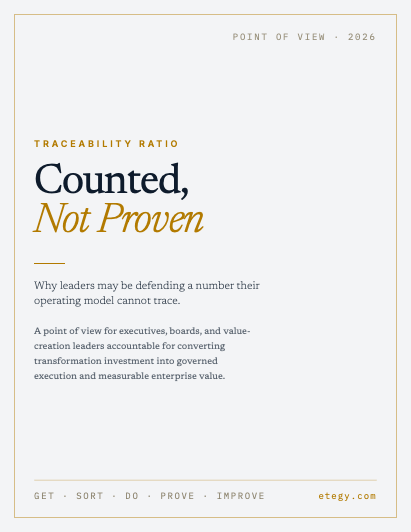
Counted, Not Proven — cover

You just read the argument. The formatted edition lays out both figures, both exhibits, and the worked Traceability Ratio for sending or printing — no email, no form, no gate.

If the paper named a number you cannot yet prove

Four ways to engage with the argument — at the altitude that fits where you sit.

01

Run a Traceability Read

Put a reported number in front of the GSDPI lifecycle. A scoped read reconciles detected work against governed origin and returns a directional Traceability Ratio — where the 0:1 pools, and what it puts at risk.

Request a Traceability Read →
02

Brief a board or leadership team

A working session for a board, executive team, or PE portfolio on what a reported number can and cannot prove — and the standard that separates work that is counted from work that is proven.

Invite a briefing →
03

Pressure-test a number in flight

Interim or fractional support where a value-creation claim already exists but the proof base underneath it does not — before the next board read, results call, or diligence cycle tests it for you.

Discuss interim support →
04

Stay close to this work

Request future ZBT and Transform the Core papers, executive briefs, and briefing invitations without booking a call. No newsletter cadence. No drip campaign.

Request related content →
Darrin Devereaux
Darrin Devereaux
Founder & Chief Transformation Officer, ETEGY

Over twenty-five years, Darrin has led 60+ board- and PE-sponsored transformation mandates across services organizations from $400M to $20B in scale — originating Zero-Based Transformation and the GSDPI lifecycle this paper builds on. Earlier, he commercialized the ADKAR methodology into an enterprise advisory practice at Prosci. He is completing a Doctor of Business Administration in Strategic Management.

60+
Board & PE mandates
$400M–$20B
Organization scale
20–30%
Variance reduction
12–18%
EBITDA improvement
Discuss an engagement